
Water Damage in a Boise Bench Rental: Who Does What for Landlords and Tenants

In a rental, a leak has two people to answer to.
Rental water damage on the Boise Bench gets complicated fast, because the person who finds the water usually isn’t the person who owns the walls, floors, and pipes. A tenant spots a puddle under the sink or a soft spot by the washer; a landlord may be across town or across the country. This guide breaks down who does what in the first hour and the first few days, how Idaho’s written-notice rules work, which insurance policy covers what, and how to keep a fixable leak from turning into a mold problem and a dispute.
Why Rentals on the Boise Bench See Their Share of Water Calls
The Bench is the raised plateau south of the Boise River. A City of Boise Central Bench history notes that Boiseans have called it “the bench” since at least 1900, that farms and orchards came first, and that irrigation canals made settlement possible. Many of those canals and laterals still run today, mostly watering yards and gardens, and the same report says flooding from deteriorating laterals is not uncommon because the piping has been in service for more than a century.
Like the rest of Boise, the Bench has rentals of many different ages, so the plumbing behind the walls can be anything from decades-old lines to a recent remodel. Water damage in a rental isn’t harder to dry than in an owner-occupied home. It’s harder to coordinate, and slow coordination is what lets small leaks grow.
Who Is Responsible for What: Landlord vs. Tenant
Every lease is different, and the lease should spell out who handles repairs and maintenance. The Idaho Attorney General’s Landlord and Tenant Manual lays out the general split under Idaho law. This is a plain-language summary, not legal advice; for a specific dispute, talk to a private attorney, as the manual itself recommends.
The landlord’s side
- Under Idaho Code § 6-320, a tenant can take action if the landlord fails to provide reasonable waterproofing and weather protection, or fails to keep landlord-supplied plumbing, heating, and similar systems in good working order.
- The same statute covers keeping the premises in a condition that isn’t hazardous to the tenant’s health or safety.
- In practice, that means the building itself: the roof, walls, supply and drain lines, water heater, and repairs to drywall, flooring, and cabinets the landlord owns.
The tenant’s side
- The AG manual says tenants must safeguard the rental and help prevent damage, including using plumbing and appliances properly and keeping guests from damaging the property.
- If a tenant’s carelessness or negligence causes damage, the manual notes the tenant may have to pay the landlord for it.
- Tenants are usually the first to notice a problem, so prompt reporting is part of the job. The manual passes along Idaho Department of Health and Welfare advice to notify the landlord right away about plumbing leaks, excess moisture, or mold that keeps coming back.
One rule surprises a lot of renters: according to the AG manual, Idaho law generally does not let tenants withhold rent over unsafe conditions, or make the repairs themselves and deduct the cost. (Smoke detectors are the one narrow exception.)
The First Hour: A Side-by-Side Plan
If you’re the tenant
- Stop the water if you safely can. Close the valve under the sink or toilet, or the washer’s supply valves. If you can’t find a local valve, find the main shutoff. It’s worth asking your landlord where it is on move-in day.
- Keep away from electricity. Don’t touch outlets, cords, or appliances while standing in water.
- Call or text the landlord or property manager right away, then follow up in writing the same day, even for an emergency.
- Take photos and video of the source, the spread, and your own belongings before you move them.
- Move your things to a dry room and set rugs, electronics, and papers up off wet floors.
If you’re the landlord
- Respond fast and get eyes on it. Wet drywall, subfloor, and cabinets don’t wait for a convenient appointment.
- Get the source repaired by a plumber or the right trade before or alongside drying.
- Call your insurance agent and get a restoration company on site to measure moisture and start drying.
- Give proper notice before entering, as your lease and Idaho law require, unless it’s a genuine emergency involving life or property. The AG manual lists responding to that kind of emergency as one of the reasons a lease should allow entry.
- Keep the tenant in the loop about what’s being removed, how long equipment will run, and whether any rooms are off-limits.
The EPA’s guide to mold and moisture advises drying water-damaged areas and items within 24 to 48 hours to prevent mold growth. That window is why the first phone call matters more than who ends up paying.
Put It in Writing: How Idaho’s Notice Process Works
A phone call gets help moving. A written notice protects both sides. The AG manual explains that to require a landlord to fix a problem, a tenant must first give the landlord a written list of the violations, delivered in person, by trained mail, or left with an employee at the landlord’s usual place of business. The landlord then has three days after the notice is served to make the repair before the tenant can go to court to force compliance.
For a burst line or an active leak, nobody should wait three days to start. Treat the written notice as a record, not a reason to delay. A good notice includes:
- The date and time you first noticed the water, and where it is.
- What you did right away (shut a valve, called the landlord, moved belongings).
- Photos or video, with the date they were taken.
- A clear request for the repair and drying needed.
Landlords who think a tenant caused the damage have their own written-notice steps in the same manual. Either way, a timeline with photos makes conversations with insurers much easier, too.
Which Insurance Covers What?
This is where most rental water claims get tangled. The Idaho Department of Insurance explains that a renter’s policy covers the tenant’s household contents and personal belongings and typically includes liability coverage, but it does not cover the structure of the home or apartment being rented. The AG manual also encourages tenants to consider buying renter’s insurance.
- The building (drywall, flooring, cabinets, framing): generally the landlord’s property policy. Coverage depends on the cause and the policy wording.
- The tenant’s belongings (furniture, clothing, electronics): the tenant’s renter’s policy, if they have one. A landlord’s policy generally won’t pay for them.
- Extra living costs if the unit can’t be lived in for a while: check the renter’s policy for additional living expense coverage, and read the lease.
- Liability when one party’s mistake damages the other’s property, or water from one unit damages a neighbor’s: each policy’s liability section, and the specifics of what happened.
Both sides should call their own agents early and share the same photos and timeline. Disaster Cleanup can document moisture readings and work for the claim, and you can pay after your insurance claim closes.
Preventing Mold Problems and Move-Out Disputes
The AG manual points out that Idaho has no government agency that regulates mold inspection or removal in rental property. That puts the burden on landlords and tenants to catch moisture early. Signs worth reporting right away:
- A musty smell in a closet, under a sink, or behind the washer that wasn’t there before.
- Baseboards that are swelling, separating, or stained.
- Paint that bubbles or drywall that feels soft near the floor.
- Spots that come back after cleaning around tubs, windows, and toilets.
For landlords, a quick check under sinks, around the water heater, and behind the washer during routine visits or at turnover catches a lot of slow leaks. Braided supply hoses, drain pans, and leak prevention systems with sensors and automatic shutoffs can alert someone even when the unit is empty between tenants. If mold has already started, our mold remediation team can contain and remove it properly.
What Professional Drying Looks Like in an Occupied Rental
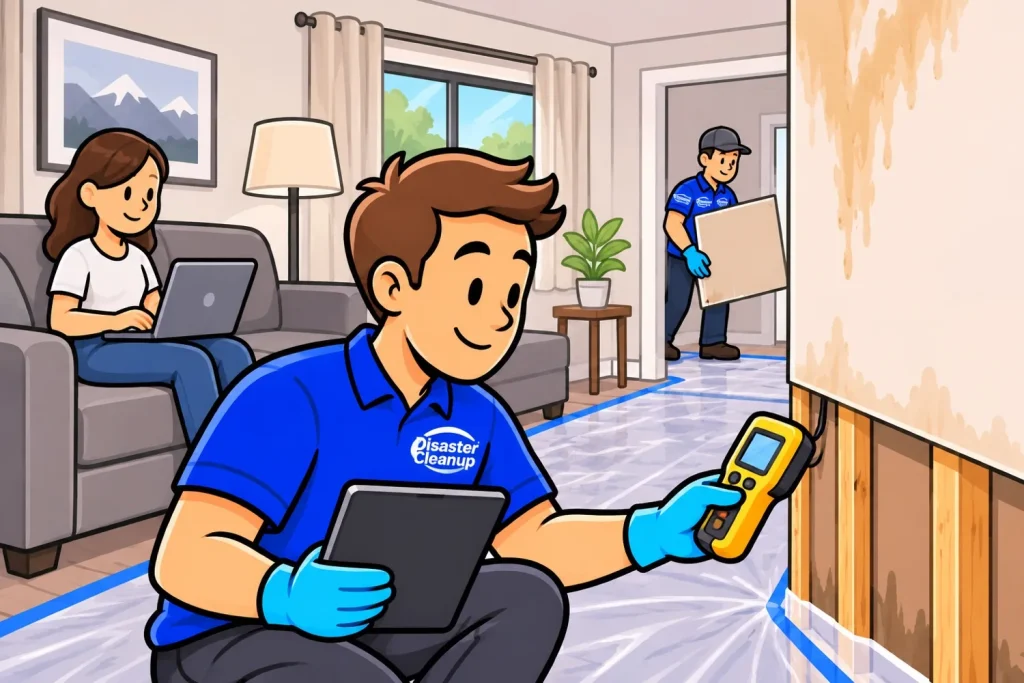
Drying a rental with tenants still living in it means planning around their daily life. On a typical water damage restoration job, we:
- Find where the water traveled with moisture meters, since it often wicks well past the visible stain.
- Remove what can’t be saved, such as soaked pad or swollen cabinet toe-kicks, and explain what’s coming out and why.
- Set dehumidifiers and air movers, then check readings until materials are back to dry standards.
- Keep notes and photos that both the landlord and tenant can share with their insurers.
Older Boise homes have their own weak spots, too. Our guide to basement flooding in the North End covers sewer laterals and older foundations, and our Garden City water heater leak guide includes a homeowner-vs-renter plan for that common failure.
Need Help With Water Damage in a Boise Bench Rental?
Disaster Cleanup is a veteran-owned restoration company serving Boise, the Bench, and the Treasure Valley since 2015. Whether you own the rental or live in it, local pros answer our phones live 24/7, and we’re typically on site within 1–2 hours. Call (208) 999-2353 or schedule a free inspection. You can pay after your insurance claim closes, all work is backed by a 1-year warranty, and se habla español. Idaho contractor registration RCE-67826.
Boise Rental Water Damage FAQs
I’m a tenant. Can I call a restoration company myself?
You can always call for advice, and in a true emergency, getting help moving matters. Because the landlord owns the building and usually handles the repair and the property insurance claim, contact them at the same time and agree on who is authorizing the work.
Can I stop paying rent until the leak is fixed?
Generally, no. The Idaho Attorney General’s manual says Idaho law generally does not allow tenants to withhold rent over unsafe conditions. Its described route is written notice to the landlord, three days for the repair, and then court action if needed. Talk to an attorney about your specific situation.
Does my landlord’s insurance cover my ruined couch?
Usually not. According to the Idaho Department of Insurance, a renter’s policy is what covers a tenant’s personal belongings, and it does not cover the building itself. Check your own policy and call your agent.
How fast does a wet rental need to be dried?
The EPA recommends drying water-damaged materials within 24 to 48 hours to help prevent mold. That’s why it pays to report water the moment you find it, even late at night or on a weekend.
Who decides what gets torn out?
The property owner authorizes work on the building, usually with input from their insurer. We measure moisture, explain what can be dried in place and what can’t, and document it so the landlord, the tenant, and both insurers are working from the same facts.
Rental Water Damage Terms to Know
Written notice: A dated, written list of problems a tenant gives a landlord (or a landlord gives a tenant) that starts Idaho’s timeline for repairs.
Renter’s insurance: A policy that covers a tenant’s personal belongings and typically liability, but not the building.
Additional living expenses: Policy coverage that may pay for extra lodging and food costs when a home can’t be lived in after a covered loss.
Lateral (irrigation): A smaller ditch or pipe that carries irrigation water from a main canal to neighborhoods and yards.
Moisture mapping: Using meters to trace how far water has spread into walls, floors, and cabinets, including areas that look dry.