Commercial Water Damage in Caldwell, Idaho: A Holiday-Season Plan for Downtown Shops and Restaurants
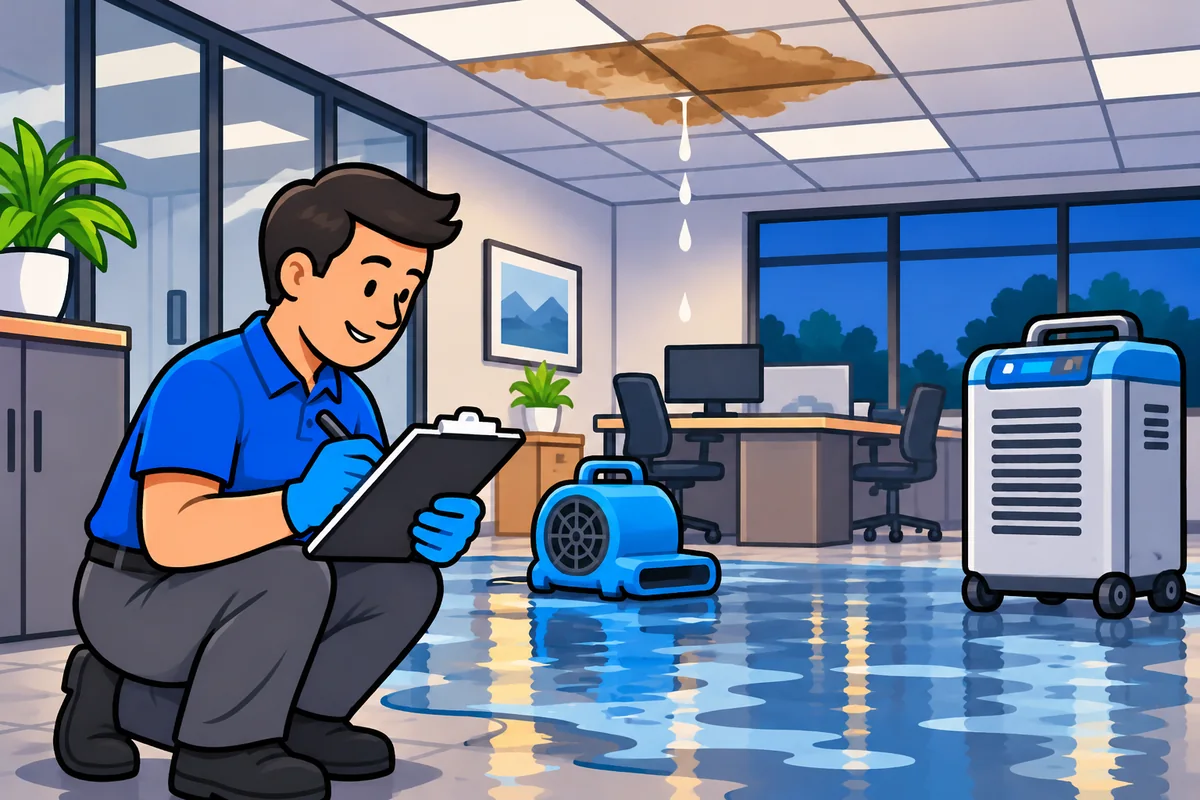
The busiest weeks of the year are the worst weeks to find a flooded stockroom.
Commercial water damage in Caldwell, Idaho tends to show up at the least convenient moment: a split line in a back hallway the morning of a big sale, an ice machine leaking under a kitchen line during a holiday dinner rush, or a ceiling stain spreading over a sales floor below an upstairs apartment. Downtown shops, restaurants, and offices near Indian Creek Plaza run hard from Thanksgiving through New Year’s, and a few hours of standing water can mean wet inventory, closed doors, and a slow insurance process. This guide explains why downtown Caldwell buildings deserve a winter water check, how to tell clean water from contaminated water, a two-level check you can run at closing time, common myths, prevention steps for the holiday rush, and what a professional commercial restoration job looks like.
Why Downtown Caldwell Businesses Deserve a Winter Water Check
The City of Caldwell’s downtown walking tour is a reminder of how much history sits along Main Street, Kimball Avenue, and Arthur Street. Several storefronts date to the early 1900s and have been remodeled many times, while newer mixed-use buildings put apartments above ground-floor retail. The same guide notes that Indian Creek once ran under concrete, and that a car fell through into the creek at the Like Nu Car Wash at 10th and Arthur in late 2001, which helped start the downtown revival. Today, Indian Creek Plaza draws crowds all winter, and the city decorates the creek with over a million lights for Winter Wonderland.
More foot traffic means more restroom use, more dishwashing, and more people tracking snowmelt across floors, all inside buildings with old pipes, shared walls, and upstairs neighbors. The EPA’s guide to mold remediation in schools and commercial buildings is written for building managers and custodians, and it notes that mold can grow on wood, paper, carpet, and insulation when moisture goes unaddressed. The EPA also advises drying wet materials within 24–48 hours to prevent mold growth. (epa.gov)
Clean Water or Contaminated Water? How to Tell the Difference
The source of the water decides what can be saved, who can stay in the space, and how cleanup has to be done. In a business, that also decides whether you can stay open while the work happens.
Signs that point to clean water
- The water is clear and odorless and traces back to a supply line, a water heater, or a sink faucet.
- The leak comes from an ice machine, coffee brewer, or beverage line that feeds from the building’s fresh water.
- It stops quickly when you close the fixture valve or the main shutoff.
- It was found within hours, before it had time to sit in carpet, cardboard, or wall cavities.
Signs that point to contaminated water
- Water rises from a floor drain, floor sink, toilet, or mop sink rather than dripping from above.
- It smells of sewage or old grease, or it carries food scraps or a gray film.
- Clean water sat long enough to pick up dirt and odor, or it ran through a dirty storage area before you found it.
Contaminated water calls for protective gear, disinfection, and stricter decisions about what has to go, so keep customers and staff out of the area. Our holiday sewage backup guide covers drain backups in more detail, and our first-day plan for business owners walks through the hours right after a leak.
A Two-Level Water Check for Caldwell Business Owners
Most commercial leaks give small warnings before they turn into a closed-door day. These two checks fit into a normal shift and catch most of those warnings early.
Level 1: The five-minute closing walk
- Look under the ice machine, dish machine, and three-compartment sink for puddles, drips, or a wet mat.
- Check restroom floors around toilets and the base of the urinal or hand sink.
- Glance up at ceiling tiles in the sales floor, stockroom, and back hallway for new rings or sagging.
- Confirm the thermostat is set for the night and that no door to an unheated back room was left open.
Level 2: The monthly back-of-house check
- Find the main water shutoff, test that it turns, and tag it so any employee can find it in the dark.
- Inspect the water heater for rust at the base, a dripping relief valve, or a damp floor.
- Pull boxes away from exterior walls and lift a corner of stored stock to check for dampness, musty smell, or curling cardboard.
- Read the water meter at closing and again before opening; if it moved while nothing ran, a hidden leak is likely.
- Ask upstairs tenants or neighboring businesses to report any leaks right away, and share an after-hours contact list.
If you find active water, shut off the supply, cut power to anything sitting in water if it is safe to reach the panel, move stock off the floor, and take photos before cleanup starts. Then call for help, because drying a commercial space takes more than shop fans and mops.
Commercial Water Damage Myths vs. Facts
Myth: “The landlord’s insurance will cover all of it.”
Fact: Many leases split responsibility between the building owner and the tenant, and the building policy may not cover your inventory, fixtures, or lost business days. Read your lease and call your own agent early so nothing falls through the gap.
Myth: “If the floor looks dry by morning, we can open as usual.”
Fact: Water wicks up drywall, soaks under vinyl plank and carpet pad, and settles into wall cavities behind shelving. A dry surface can hide wet materials that start to smell and grow mold days later.
Myth: “A little water under the ice machine is normal.”
Fact: A small, steady drip in the same spot is often a failing drain line, a loose fitting, or a clogged condensate path. Left alone, it can rot the subfloor and cabinet base long before anyone sees a puddle.
Myth: “We will deal with it after the holidays.”
Fact: Waiting turns a drying job into a tear-out job. Because the EPA recommends drying wet materials within 24–48 hours, a quick response usually protects more of the building and gets you back to full hours sooner.
The Downtown Caldwell Holiday Rush: Prevention Steps That Work
- Make a one-page water plan. List the shutoff location, the electrical panel, your landlord’s number, and who on staff makes the call after hours. FEMA’s Ready Business program lists equipment failure among the hazards a business should plan for.
- Keep the heat on when you are closed. Turning thermostats way down over Thanksgiving or Christmas Day is how back-room and exterior-wall pipes freeze and split.
- Protect pipes in unheated spaces. Insulate lines in storage rooms, loading areas, and along exterior walls, and keep those doors closed during cold snaps.
- Clear roof drains and gutters before the snow. Flat-roof scuppers and downspouts packed with leaves can back up meltwater onto the roof and into the space below.
- Add leak sensors where water hides. Place them under ice machines, water heaters, dish machines, and restroom sinks, or consider leak prevention systems with an automatic shutoff.
- Keep grease and food out of drains. Scrape plates into the trash, keep the grease trap on its service schedule, and never pour fryer oil down a floor sink.
- Store stock off the floor. Shelving or pallets a few inches up can be the difference between a wet floor and a lost holiday order.
What Professional Commercial Water Damage Restoration Involves
A commercial job follows the same science as a home, but the plan has to account for customers, staff, inventory, and often more than one tenant.
- Inspection and safety check. The crew confirms the water source is stopped, checks for electrical hazards, and decides whether the water is clean or contaminated.
- Moisture mapping. Meters and thermal tools show how far water traveled under flooring, behind shelving, and into neighboring units.
- Water extraction. Standing water is removed from hard floors, carpet, and floor drains so drying can begin.
- Controlled drying. Air movers and dehumidifiers are placed to dry the building while keeping walkways and exits clear where possible.
- Daily monitoring and documentation. Readings and photos are recorded each day, which supports your insurance claim and shows when materials are truly dry.
- Cleaning and repairs. Affected areas are cleaned or sanitized, damaged materials are replaced, and the space is put back together.
Learn more about water damage restoration in Caldwell, our emergency water removal service, burst pipe cleanup, and how dehumidifiers and air movers really dry a building.
Need Help With Commercial Water Damage in Caldwell?
Disaster Cleanup is a veteran-owned restoration company serving Caldwell, Boise, and the Treasure Valley since 2015. Local pros answer our phones live 24/7, and we’re typically on site within 1–2 hours. Call (208) 999-2353 or schedule a free inspection. You can pay after your insurance claim closes, all work is backed by a 1-year warranty, and se habla español. Idaho contractor registration RCE-67826.
Caldwell Commercial Water Damage FAQs
Can my business stay open during water damage cleanup?
Often part of it can. It depends on where the water went, whether it was clean or contaminated, and whether drying equipment can be set up away from customer areas and exits. Contaminated areas should stay closed to the public until they are cleaned.
Who should I call first, my landlord or a restoration company?
Stop the water first, then notify your landlord or property manager and get help on the way. Many leases require prompt notice, and starting mitigation quickly limits damage for everyone in the building.
Should I throw out wet inventory right away?
Move it to a dry area, but photograph and list damaged items before anything is discarded. Your insurer may want to see them, and some goods in sealed packaging can be cleaned and saved.
How long does drying a commercial space take?
It varies with the materials, how much water there was, and how long it sat. Daily moisture readings show when each area is truly dry, so the timeline is based on measurements instead of guesswork.
Does Disaster Cleanup serve Caldwell?
Yes. We serve Caldwell, Nampa, Middleton, and the wider Boise area. Call (208) 999-2353 any time, day or night, to talk with a local pro.
Commercial Water Damage Terms to Know
Clean water: Water from a supply line, faucet, or similar source that does not carry sewage or other contaminants when it first escapes.
Contaminated water: Water from drains, toilets, sewage, or flooding, or clean water that has sat long enough to pick up dirt and bacteria.
Floor sink: A recessed drain in a commercial kitchen that collects water from equipment such as ice machines and dish machines.
Moisture mapping: Using meters and thermal tools to chart exactly where water has spread, including areas you cannot see.
Business interruption coverage: A type of commercial insurance that may help replace lost income while a covered loss keeps your doors closed. Check your own policy for details.